

There are some deaths that feel particularly cruel, not because death is ever fair. It isn’t. At the same time, sometimes the person who dies has spent her life trying to understand exactly how to keep people alive.
Dr. Jill Tirabassi was one of those people.
Jill was a physician in Buffalo, New York. She was a researcher, an educator, an advocate, a wife, a mother, an athlete, a gardener, a hiker and so much more. She was forty years old when she died on September 7, 2026.
Forty. There is something almost impossible about writing that number.
Jill was diagnosed with Stage IV Metastatic Breast Cancer (MBC) on October 13, 2022, the one day each October dedicated to Metastatic Breast Cancer, while pregnant with her second son. She was thirty-six. Her diagnosis was de novo, meaning the cancer was metastatic from the beginning. There was no earlier version of Jill’s breast cancer that could be neatly separated from the metastatic disease. There was no “before” that made sense in the way people like to imagine there should be one. (Metastatic Breast Cancer Alliance)
And yet Jill did what so many of us in the MBC community do; she lived. Not because she was naïve about what MBC means. Quite the opposite. She understood it better than most.
She was a doctor.
Jill knew the language of medicine. She understood scans and laboratory values and treatment plans. She knew what progression meant. She knew what the statistics said.
But she also knew something that medicine sometimes struggles to quantify: A patient is not a statistic, a person is not a tumor and a life cannot be reduced to progression-free survival.
Jill brought that dual perspective, doctor and patient, to everything she did.
She worked in sports, family, preventive and lifestyle medicine. She researched food literacy and the ways that lifestyle and medicine intersect. She believed in movement. She believed in being outside. She believed that food mattered. Her obituary says something that I think tells us almost everything we need to know about her: she was a physician who “practiced the way she preached.” She believed that food, movement, and time outdoors were medicine. (Tribute Archive)
And she wasn’t simply talking about those things in a sterile exam room, she lived them.
Jill loved gardening. She hiked. She spent time outside with her sons, looking for deer and foxes in the backyard and watching for monarch butterflies. Her obituary says that she was happiest with dirt on her hands. (Tribute Archive)
I love that.
Because cancer is so very interested in turning us into bodies. Tumors. Organs. Receptors. Mutations. Numbers. Jill insisted on remaining a person.
And then there was Live From Stage 4.
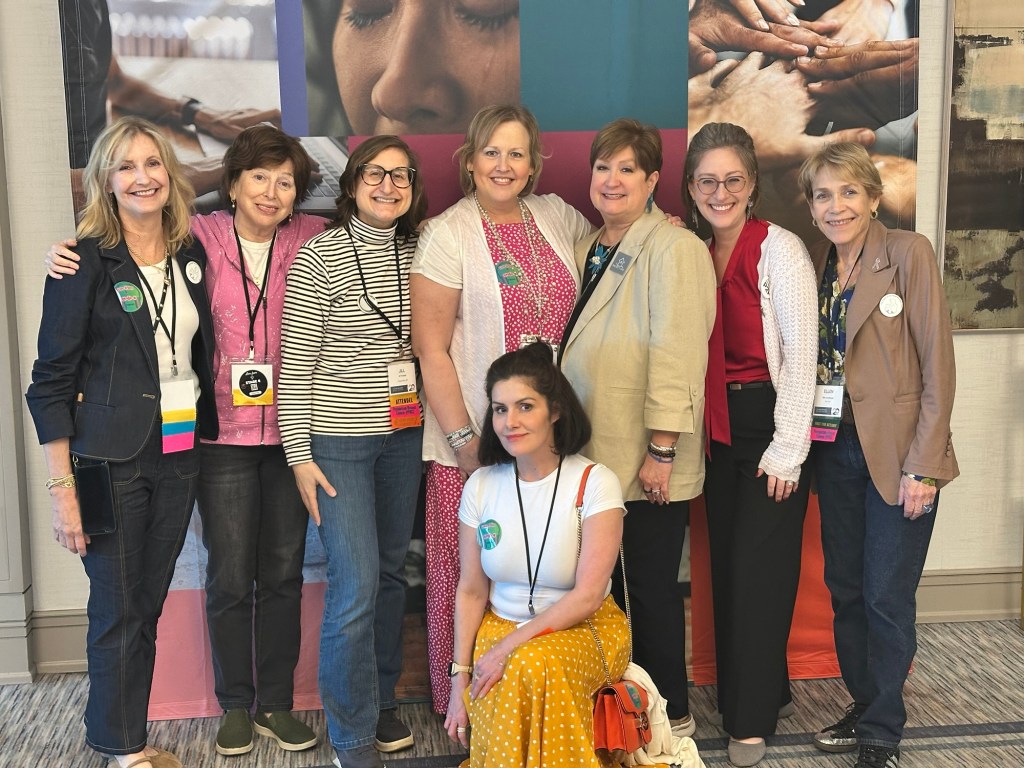
For those of us who are part of this amazing podcast, Jill was an integral part of the team. She helped make it what it is and brought all of herself to that endeavor. She showed up over and over even when she was struggling.
Live From Stage 4 exists because people living with MBC deserve information that speaks to them rather than around them. Jill understood that mission instinctively. The podcast describes itself as MBC news “for us, by us,” bringing together people living with MBC, clinicians, researchers, and advocates. Jill was uniquely suited to that space because she was all of those things at once. (Live From Stage 4)
She helped make complicated science understandable. She asked the questions that patients actually need answered. And she brought something else to the microphone: credibility. Not the distant credibility of someone who has read about cancer.
The credibility of someone who has cancer.
Jill hosted and wrote the S**t We Deal With segments, including an episode about the enormous “time burden” of living with MBC. She took research and translated it into the lived reality of patients: the appointments, the travel, the waiting, the medications, the scheduling, the endless administrative work of remaining alive. (Live From Stage 4)
There is something almost unbearably poignant about that now. Jill was documenting the work of living with MBC while she was living it herself. She was putting words around an experience that so many of us know intimately in real time.
Also check out the Heated Rivalry episode where our executive producer, Victoria Goldberg, and Jill discussed the series and shared quire vulnerably about themselves.
And then MBC killed her. I don’t use that language lightly. Cancer didn’t “win.” Jill didn’t “lose her battle.”
Those phrases have never made much sense to me. They imply that if a person dies, perhaps she simply didn’t fight hard enough. As though MBC is an opponent that can be defeated through sufficient courage, positivity, exercise, good food, prayer, treatment, or willpower.
It can’t be.
Jill did not fail. Her doctors did not fail. Her family did not fail. She was killed by MBC, a disease that she spent years trying to understand. A disease she worked to educate others about. A disease she advocated against. A disease she carried while raising two little boys.
That is the cruelty, but it is not the whole story; because Jill’s life was considerably larger than the disease that eventually ended it.
She was Adam’s wife. She was a mother to her precious boys. She was Christopher and Theresa’s daughter. She was Alison and Brittney’s sister. She was a friend, colleague, doctor, researcher, teacher, advocate. And she was a woman who really did get dirt under her fingernails.
Those things matter.
They matter because cancer has a way of becoming the loudest thing in a person’s biography. Jill’s diagnosis was extraordinary. Her advocacy was extraordinary. Her death is devastating.
But her life was not extraordinary because she had cancer. Her life was extraordinary because she was Jill.
That is what I want to remember. I want to remember the doctor who understood that patients needed more than prescriptions. The researcher who believed patient voices belonged in research. The advocate who believed that postpartum breast cancer deserved more attention. The mother who took her boys outside. The woman who gardened. The woman who hiked. The woman who sat behind a microphone and talked about the shit we deal with. The woman who helped make Live From Stage 4 something more than just a podcast.
And I want to remember that she was still doing that work remarkably close to the end.
There is a particular kind of grief that comes when someone in the MBC community dies. It is grief, obviously, but it is also recognition. We know what she knew (well, some of it). We know the appointments. We know the scans. We know the blood draws and the infusions and the waiting. We know the strange experience of trying to fold the laundry while wondering what the next scan will show. We know what it means to love people fiercely while simultaneously understanding that MBC will someday take us away from them and so when someone like Jill dies, it isn’t simply another obituary.
It is a mirror.
It reminds us that MBC is still terminal, even when the person living with it is a physician. Even when she exercises. Even when she eats well. Even when she understands the science. Even when she advocates. Even when she is doing everything she can.
But Jill also leaves us something; she leaves us evidence that a life with MBC can contain enormous purpose. She leaves two little boys who knew their mother loved them enough to look for butterflies. She leaves a husband who knew her love. She leaves patients who were cared for by a physician who understood what it meant to be on the other side of the exam table. She leaves research and advocacy and conversations that will continue without her.
And she leaves Live From Stage 4. Her voice is still there. That matters, because death may have taken Jill’s body but it did not take the things she taught us. It did not take the questions she asked. It did not take the research she championed. It did not take the patients she helped. It did not take the podcast episodes she made. It did not take the love she poured into her boys.
MBC did not and cannot take the life she lived.
Forty years is not enough. Four years with MBC is not enough. Two little boys losing their mother is not enough. None of this is at all acceptable but Jill’s life was not measured only by its length; It was measured by its reach. And Jill reached a lot of us.
Cancer, even MBC, is not in charge. It can take a person’s physical body, but it cannot take what the person who hurt cancer gave away. So we will keep talking. We will keep asking harder questions. We will keep demanding better research. We will keep making complicated science understandable. We will keep telling the truth about what MBC costs. We will keep living with both feet firmly planted in the dirt.
And when we do, there will be a little bit of Jill there, because that is how we survive losing each other. Not by pretending the loss isn’t enormous, but by refusing to let the person become only the thing that killed her.
Jill was so much more than MBC. And she still is.

 No Half Measures
Such a beautiful tribute to Jill in the midst of the heartbreak and grief. Praying for you, her precious family, and all who loved her.
🙏💔
LikeLiked by 1 person