

I confess that I’m not a big football fan but usually pay enough attention to the annual Super Bowl for the half time show and the commercials. This year was no different, but I found myself more horrified than intrigued with the cancer commercials from Novartis and Pfizer this year. And some are saying that’s the point, that the marketing efforts were designed to do that, get people to wake up and pay attention; also, that someone like me simply isn’t the audience for the millions of dollars that was spent while patients are reeling from cuts to the programs that help us afford our medication.
Let that sink in for a minute, both Novartis and Pfizer have changed the criteria for their patient assistance programs so significantly for 2025 that many patients who are already dying from breast cancer can no longer afford their medication, yet spent millions on Super Bowl commercials.
I get it, pharmaceutical companies are for-profit businesses, not charities. They are responsible first to their shareholders to continue to make money off of the medication they develop and breast cancer medication is big business. Different numbers are often used, but I’ve seen suggestions that over 360,000 people in the United States are living with breast cancer, perhaps about 250,000 living with terminal breast cancer like me. Case on point, the revenue that Pfizer has been paid through Medicare patients prescribed Ibrance from October 2023 to October 2024 is public record here since Ibrance is on the list for price negotiations under the Inflation Reduction Act (IRA) in 2025 (hint, it’s nearly 2 billion paid in a 12 month period for one medication). Breast Cancer is huge business, which means it is easy to overlook the human element, that every data point in clinical trials and on lists of people getting medication is a human being.
Continuing to emphasize the sexualization of a disease that affects 1 in 8 women is harmful to all of us, not just those of us who have already received the worst news of our lives. It minimizes the seriousness of a deadly disease that murders at a rate of 117 people every day in the United States and even more worldwide. It perpetuates the narrative that breast cancer is an “easy cancer.” It further affects the ability of people to have their medical teams take us seriously when public opinion is influenced to look first at the sexual connotation of a body part. Focusing on women’s breasts ignores how men make up approximately 1% of people diagnosed with breast cancer. A commercial like this changes the focus of the public, something that will quite literally kill more people. When breast cancer is sexualized, every single person loses.
Let’s review some of the details of the Novartis commercial that highlight how much it misses the mark on the human elements of breast cancer and quite literally harms us all.
First, many of the bouncing breasts featured in the majority of the commercial belong to young women likely too young to get mammograms, which was the focus of the commercial, to inquire about screening. I get it, those of us over 40 don’t have the same firm bouncing boobs any longer. Those body parts aren’t so pretty after years of breastfeeding and living and surgeries and radiation and port surgeries. Focusing on the breasts of women too young for mammograms demeans and dismisses the struggles that those of us diagnosed under 40 often face in getting screening covered and it’s even harder while breastfeeding.
Second, only featuring women’s breasts entirely ignores the men who are diagnosed with breast cancer. While men make up about 1% of the diagnoses with breast cancer each year, the majority are diagnosed at a later stage, Stage III or IV, and their experiences are often vastly different from women. The commercial ignored all of these people and could have made it even harder for men to have their concerns addressed — if people are only focusing on the young, bouncing breasts, it sidelines everyone else, the people who need help. When you don’t fit the “box,” getting treatment can be really difficult and tone deaf commercials affecting public opinion only makes it more difficult to get the screening and treatment people need.
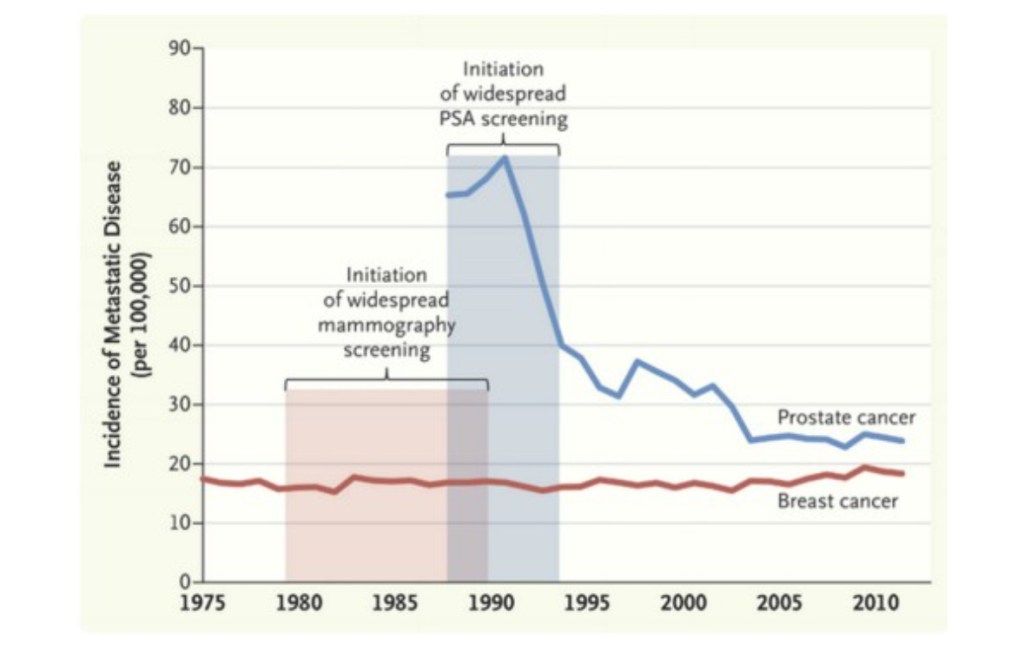
Third, the message that “early detection” saves lives or even as a “game changer” is misleading, at best. Statistics and data show us that every person who has a diagnosis of early stage (0-III) breast cancer has an approximate risk of 30% that they aren’t actually cured, that their disease will progress to Stage IV. Doesn’t matter which stage or how early, every person diagnosed with breast cancer has a different individual risk of becoming terminal like me. The percentage of cancer patient’s who progress from an early stage diagnosis to Stage IV hasn’t changed since the 1970s, since before I was born — see below for an article and image reflecting this data from the New England Journal of Medicine. Screening/mammograms hasn’t moved the needle on the percentage of people who progress to Stage IV, in fact, the incidents of breast cancer diagnosed in women under 40 is the only segment of the population where breast cancer diagnoses are increasing and those of us diagnosed pre-menopausal die a whole lot faster than those diagnosed later.
One organization that issued a statement I can get behind is Twisted Pink and I’d like to end with their conclusion, with how to move forward as we all must:
Moving Forward: What the Commercial Can Teach Us
While the backlash against Novartis’ Super Bowl commercial is valid, it is also an important reminder of the power that corporate messaging holds. Advertisers should be mindful that public health issues, especially those as deeply personal and universally affecting as breast cancer, should not be reduced to marketing strategies. Rather than relying on dramatic visuals and emotive messaging, brands need to step up and engage in authentic dialogue. They should be a part of the conversation, not just an observer — addressing systemic issues, supporting nonprofits, and partnering with organizations that are already doing the vital work to make a real difference.
As we move into a new era of awareness campaigns, it’s critical that corporations — and the healthcare industry at large — prioritize transparency and empathy over profits. The Novartis ad may have sparked conversation, but it’s time for all of us to think beyond the spectacle and focus on what truly matters: the real-world impact of breast cancer and the fight for equitable care and resources for all those affected.
In the end, awareness should never come at the expense of the individuals it’s meant to help. And as the conversation around Novartis’ controversial ad continues to evolve, let’s hope it leads to greater responsibility in how health issues are presented, marketed, and, most importantly, addressed in our society.
…. “awareness should never come at the expense of the individuals it’s meant to help.”
 No Half Measures
I was offended by their commercials and my husband said “there for breat cancer.” He didn’t get my point.
LikeLiked by 1 person
Another critically important, highly educational post from you, dear Abigail!
LikeLiked by 1 person
Your insights are always so helpful, thank you!! ❤️
LikeLiked by 1 person
Agree!!!Sent from Samsung Galaxy smartphone.
LikeLiked by 1 person
Excellent points, as always. I think another side of this is, with the approval of CDK4/6 inhibitor(s) for early stage BC, “early detection” will keep patients a longer time on these meds or put them on the meds sooner, and hence increase the profits. But of course “early detection saves lives” sounds better…
LikeLiked by 1 person
I agree with you and it is always my hope that the experimentation they do on us will help others someday.
LikeLike
Well said Abigail. All pharmaceutical commercials in the USA disgust me and should be banned, but this one totally missed the mark.
LikeLiked by 1 person
Abigail – I’m finally seeing this and you hit the mark, 100%. I got into a “disagreement” with some of the advocates at TBCRC, one of whom sent us all a link to the ad and told us to send it out to make it go viral. I wrote back with many of your points though not as well written of course and still got pushback about screening, “if one woman gets a mammogram it will have been worth it” and other BS. It won’t surprise you that the 2 advocates who agreed with me have MBC – Christine and Teri. No surprise at all. XOX, Ellen
LikeLiked by 2 people