

After receiving three different ports after my de novo Stage IV Metastatic Breast Cancer (MBC) diagnosis in 2017, I’ve collected a few important things to think about along the way that I’d like to share. Not everyone living with MBC has a port and not all patients living with MBC desire one. It is important to consider the pros and cons of every decision, keeping in mind those things that are important to each individual person; at the same time, it’s hard to know what to ask and when.
Port #1 (non-power port, no name)
I received my first port from my breast surgeon, a non power port, in the context of what we believed was a Stage II diagnosis in mid-2017. At that time, prior to scans confirming that my actual diagnosis was Stage IV, we believed that I would have approximately sixteen (16) doses of chemotherapy and be done with the chapter of my life that included breast cancer. What we didn’t discuss at the time of the insertion of that first port was the distinction between a power and non power port, something that became more important as time went on — basically, non power ports don’t have the ability to handle contrast, so while I could get bloodwork done and medication through the port, I still had to get contrast for scans in a peripheral vein.
During COVID, I learned about port flushes as we started spacing out my appointments as much as possible. Initially, I got bloodwork regularly from my port, so it didn’t come up. But when I was on oral medication and my doctor didn’t want me in the cancer center regularly for bloodwork, I learned that getting a port flush every 4-6 weeks to maintain functionality was key.
The third lesson I learned with that first port was the importance of heparin flushes. When I was treated in Miami at the Miami Cancer Institute (MCI) and every time I travel to the Mayo Clinic in Jacksonville, after my port was de-accessed, I was given a flush of heparin. When I moved from Miami to Orlando, I discovered that heparin flushes aren’t standard of care everywhere and when I started having issues with getting blood return from the port, I discovered that that flushing made a difference for me.
Port #2 (power port, no name)
As time went on, even though I convinced my local doctor to ensure that I got the heparin flushes, it happened more and more that my port wasn’t working properly — i.e., blood didn’t come out of the port as easily. I learned a great deal about TPA, a/k/a tissue Plasminogen Activator. TPA is an injection that can be inserted into the port and after 30-60-90 minutes the port usually starts working again.
Another term, “port calisthenics” became a regular occurrence — these are all the movements nurses will have a patient try to get the blood flowing through the port. I all but stood on my head in an effort to encourage blood return, sometimes making my appointments for IV medication start later and later. Eventually, a “fibrin sheath”” was noted on my PET scans and I started thinking about a new port.
I chose to get my second port, a power port, through Interventional Radiology (IR) versus going back to my original breast surgeon who inserted the first port and I learned a little about being allergic to derma-bond, the glue they used to close the two incisions. Thankfully, a bit of baby oil helped to remove the remaining bits of glue and we dutifully updated my allergy list to ensure that I won’t have that reaction again.
Another challenge that came up with IR was that the group who inserted my 2nd port did not assign a person to a patient’s case until the day of the procedure, meaning that there was no time to ask questions and get concerns addressed prior to the day of the procedure. Thankfully, I’ve learned a great deal about addressing the nausea I often face after a procedure and was able to adjust.
But what I didn’t expect was to find out that my anatomy is a bit short and the port wasn’t trimmed properly to fit that anatomy, which caused the port cannula to extend too far into my heart. That extension meant that the wall of my heart was impacted and my body’s response was forming blood clots inside my heart. Finding those clots on an echo was the basis for removing that second port, quite quickly, and starting blood thinners.
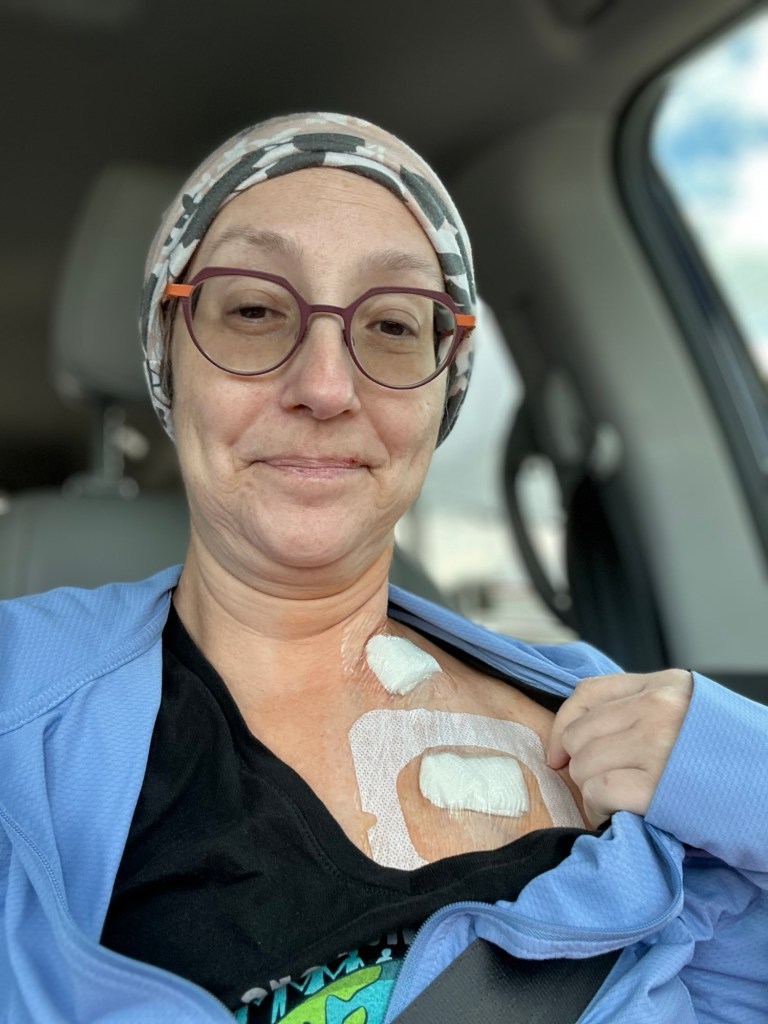
Port #3 (a power port a/k/a Portia the Equalizer)
Perhaps I didn’t fully wrap my head around the fact that that having a foreign object inside my body meant that my risk of developing blood clots (regardless of the length of the cannula) was elevated, and was already elevated due to having breast cancer in the first place. Sometimes I think perhaps it was a good thing that I wasn’t fully aware until I had to deal with it. Now that I have port #3 inside my body, which we’re affectionately named Portia the Equalizer, I’ll stay on blood thinners, and continue to get heparin flushes.
After getting these last two/three port procedures, I’ve learned the importance of being sure that the port model isn’t on the list of those that have been recalled or is under a class action lawsuit. There are those models that cause problems for patients and avoiding a port that has a history of malfunctioning or causing other issues was important to me. It was also important to me to ensure that I could speak with the interventional radiologist inserting the port and my hematologist made sure that I could speak with the person inserting my third port.
Whatever it is that makes you as a patient comfortable with a procedure, with a device, and whatever else has been recommended, I’ve learned over and over to listen to my gut and pursue that which helps me, And we’re hopeful that Portia sticks around for quite a while.
 No Half Measures
thank you for sharing valuable info once again . One question if you don’t mind. I received a power port in my arm. Got blood clots from that too but they were in arm not heart… what informs the decision , if you know, between arm placement and chest placement?
LikeLike
That’s such a great question and one I’ve discussed quite a bit over the years with various providers. My understanding is that it’s the patient’s anatomy, physician’s preference, and size of the port. Power ports can be a bit larger than the non power ports and some people have radiation damage to the skin on the chest, so it’s a big puzzle to put together (or at least that’s how I think about it).
LikeLike